
Introduction
Every so often, I hit that point where I don’t want layers. No currencies, no daily objectives, no Ultimate Team merry-go-round, no endless menus nudging me towards a store page. I just want to play football.
Lately, I’ve found myself dipping back through the classics more and more, searching for a positive way to scratch that footy itch. That’s how I found myself back with Pro Evolution Soccer 2013 on the Xbox 360, and honestly, it’s been a bit of a revelation.

PES 2013 sits in a really comfortable middle ground. It’s old enough to feel nostalgic, but not so dated that it becomes a chore. Matches load quickly, menus are straightforward, and once you’re on the pitch, the game just… lets you play. Compared to modern football titles, which often feel like full-time jobs disguised as games, PES 2013 feels refreshingly human. As mentioned, I was actively looking to avoid the bloat of modern games and the sluggishness of contemporary football sims. FIFA, in particular, feels slow, heavily scripted, and oddly stiff. Players often feel like you’re dragging them through animations rather than flowing naturally through creative play.
It’s quietly become my comfort football game — and I’m not exaggerating when I say I’ve flown through at least five Master League seasons during this run. It’s the one I boot up when I’ve got half an hour after work and just want to enjoy the sport again.
Gameplay & Mechanics
What strikes me most about PES 2013 is how alive it feels. The ball isn’t magnetised to players’ boots. It can bobble, break loose, take a heavy touch at exactly the wrong moment. And that unpredictability is the magic. In modern games, the ball often feels like it travels on very prescriptive paths. With many of these older titles, you get wild deflections, scrappy moments, and the occasional fluke — the sort of chaos that actually makes football feel like football.
Passing has weight. You feel the difference between a rushed clearance and a perfectly timed through-ball. Sometimes things come off beautifully, other times they don’t — and crucially, that usually feels like your fault rather than the game pulling strings behind the scenes. That said, one major issue I’ve had is passing in the final third. On too many occasions, the AI seems to add excessive power or a heavy touch to what should be a simple through-ball, sending it straight to the keeper instead of into the path of a clearly open attacker.
The controls have a natural rhythm once they click. First touch, body positioning, and timing matter, especially on shooting. Early on, shooting can feel a bit wild — the ball doesn’t always go where you expect — but give it time and you start to understand how the game wants you to play. Sometimes a very light touch is required; other times you really have to put some welly into it for a clean power shot. When it finally comes together, there’s a genuine sense of satisfaction that modern football games rarely give me anymore.
Difficulty-wise, the AI can be ruthless. On higher levels it will punish sloppy play, and yes, there are moments where it feels borderline superhuman especially on the break. But even then, it rarely feels cheap. You lose because you were outplayed, not because a script decided it was time for a comeback goal. That said, there is still the occasional whiff of scripting, particularly with the odd late goal.
Performance & Presentation
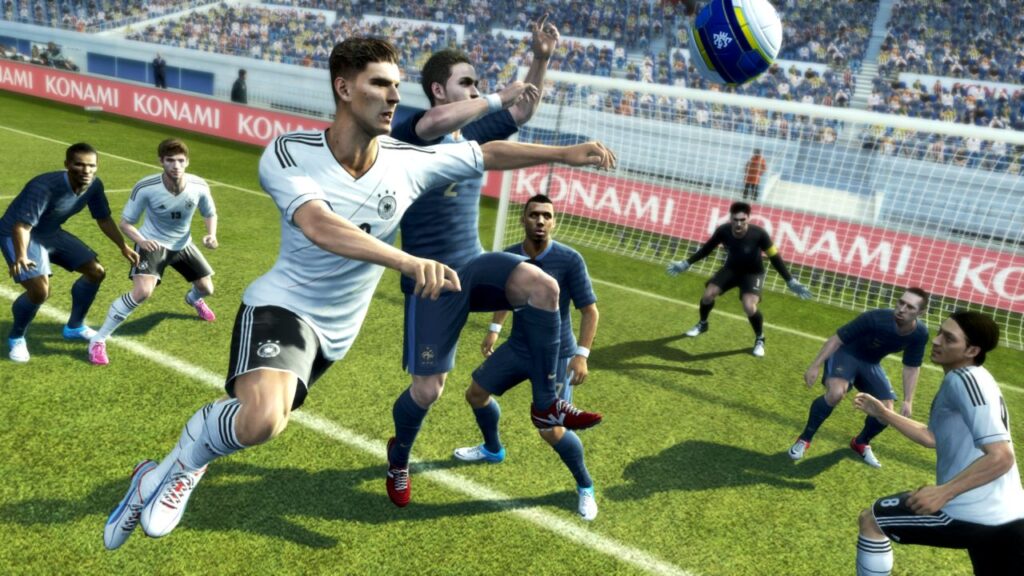
I’ve been playing PES 2013 through a RetroTINK 4K, using nearest-neighbour scaling and a 3× scale from a 720p feed on the Xbox 360. I wasn’t expecting it to look as good as it does, but I’m genuinely happy with the output. There’s a slight softness from the upscale, but it actually suits the game, smoothing the image in a way that feels almost intentional.
A RetroTINK 4K will be out of reach for some. Before this setup, I was upscaling via an mClassic fed into a PhotoFast 4K Gamer Pro — a combo that can be picked up for roughly £100–£180 depending on whether you’re happy buying used.
Animations still hold up surprisingly well. Player movement feels grounded, kits are clean, and match presentation does enough without getting in the way. It’s not flashy, but it’s confident — and that counts for a lot. Enjoy it for what it is.
Audio is classic PES. The menus have that familiar vibe, crowds respond well to the flow of the match, and commentary sits comfortably in the background. It’s never spectacular, but it’s rarely irritating either, which might be the highest compliment I can give it. It’s probably one of the weaker elements overall, but never to the point of distraction.
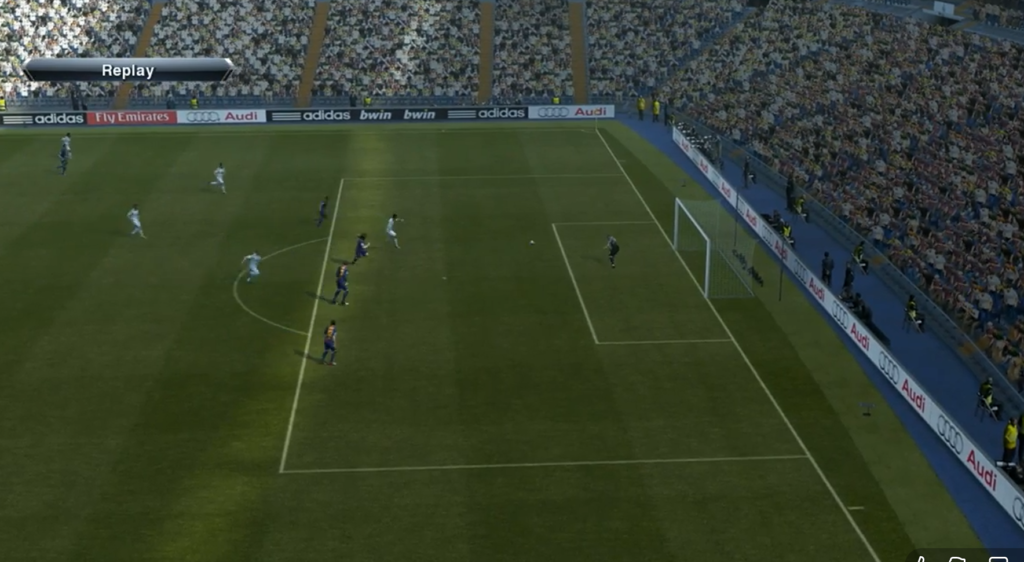
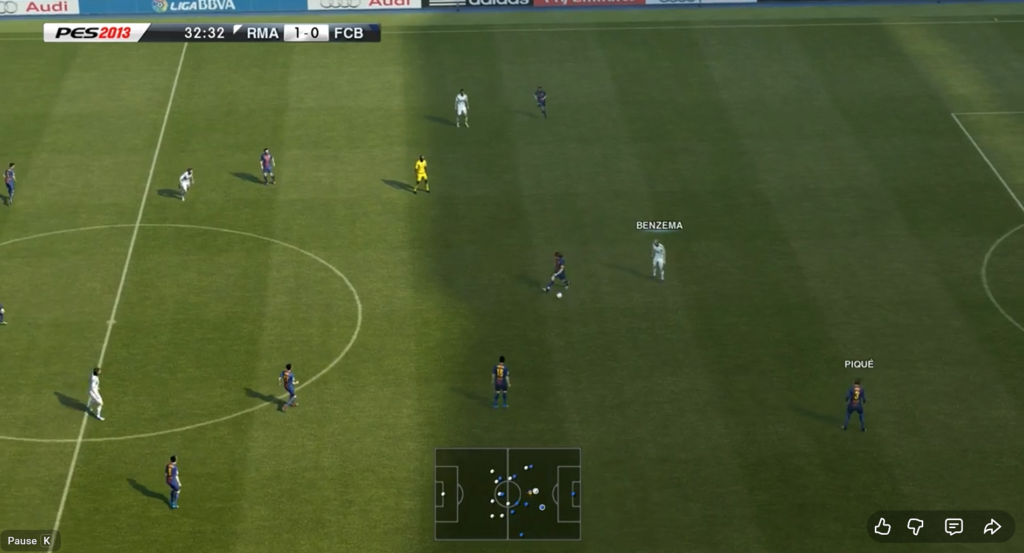
Performance is rock solid. No stuttering, no slowdown, no distracting hiccups — just smooth football, even during hectic moments like corners or fast counterattacks. This is likely helped by setting the Xbox 360’s output resolution to 720p, reducing some of the internal upscaling workload on the console itself.
Replayability & Master League
This is where PES 2013 really earns its reputation.
Master League is still brilliant. Not because it’s complex, but because it’s focused. Starting with the default squad feels meaningful, and building a team over multiple seasons has a proper sense of progression. Every signing feels earned. Every breakthrough youth player matters. That said, I’ve managed to get Chelsea to number one in the world, and I still can’t get a sniff of interest from around 95% of the top 50 players in the current season. As a three-time Champions League winner with consecutive Premier League titles, that feels a bit unrealistic.
There’s something deeply satisfying about taking a rough squad and slowly shaping it into something special though (thank you Nakata my little gem)— eventually bringing in legends like Pelé without ever feeling like the game is handing you shortcuts. No packs. No real world currencies. Just football decisions made on the pitch. The shop and equipment options in Master League feel like a bit of a poor afterthought, relying on a fairly pointless secondary in-game currency.
I’ve found myself dipping in for quick sessions and accidentally staying far longer than planned. An hour turns into two. One more match becomes a late night. That pull is still very real, even in 2025.
Customisation & Longevity
Out of the box, PES 2013 doesn’t have full licensing — but the editor is powerful, and that’s always been part of PES’ identity. Team names, kits, badges — it’s all fixable.
Even now, fan-made patches and updates are floating around online, However, I have to admit that most of these seem locked to the PC version. I’ve had no luck getting them working on the 360 due to the proprietary nature of the system. That openness is something modern football games have largely abandoned, and it’s a big reason PES 2013 continues to thrive.
Pros & Cons
Pros
- Match gameplay still feels responsive, physical, and rewarding
- Master League remains one of the strongest modes in football gaming
- No microtransactions, no grind, no nonsense
- Scales surprisingly well on modern displays with a medium- to high-end upscalers
Cons
- AI can occasionally feel overwhelming on higher difficulties
- Shooting takes time to properly understand
- Menus are functional rather than elegant
- Licensing issues require a bit of manual fixing
Tips for newcomers (You pro’s would wipe the floor with me!)
- Start Master League with the default squad — the journey is far more rewarding working your way up.
- Use an upscaler if you can; it really helps the game sit comfortably on modern TVs.
- Spend time mastering first touch and positioning — it transforms tight matches.
Final Verdict
PES 2013 still delivers in a way that feels increasingly rare. It respects your time, trusts your skill, and focuses on the football rather than the surrounding noise.
Whether it’s a quick match after work or a deep Master League save that quietly takes over your evenings, this game reminds me why I fell in love with football games in the first place.
If you’re burned out on bloated menus, scripted moments, and endless grinds, PES 2013 is well worth revisiting. There’s a reason it’s spoken about with such affection — not because it’s perfect, but because it understands what matters.
A strong recommendation — and for many of us, the last truly great PES.
One thing all of these games have in common is that they don’t waste your time.
More from Retro Tech Tonic
- Call of Duty: Modern Warfare Remastered Review – a revisit that shows how well a classic campaign can hold up with the right treatment.
- Terminator 2D: No Fate Review – an arcade-leaning throwback that gets straight to the point and doesn’t waste your time.
- Best Way to Play PS2 Games in 2026: PS3 vs PS2 FAT Mod
- The Division (2016) Review: Still the Best Winter World in 2026
- Jusant Review – A modern day masterpiece
- Terminator 2D: No Fate, a tight arcade throwback that values replayability over padding
Want to go deeper with PES 2013?
If this revisit has nudged you back towards PES 2013 and you want to explore it further, these community and reference sites are still well worth your time:
- Evo-Web PES 2013 Forum
A long-running community hub with discussions, tweaks, and deep dives into gameplay, Master League, and PES mechanics from people who genuinely know the game inside out. - PESMaster – PES 2013 Database
Ideal if you want to look up players, teams, stats, and squads from the PES 2013 era. A handy reference when planning Master League signings or reliving old line-ups. - NeoSeeker PES 2013 Wiki
A straightforward reference for modes, mechanics, and background detail if you want a refresher or need to check something specific.

Marty Brown
Gaming Hardware & Retro Tech
Marty covers the technical side of gaming — console hardware, retro setups, handheld devices, and the endless rabbit hole of finding the best way to play. From keyboard reviews to PS2 modding and hardware experiments, his articles focus on practical setups, honest impressions, and the small details that make gaming hardware satisfying to use.