
AI has been part of education for longer than most people realise — just usually in the background. Search, spellcheck, recommendation systems, even the way learning platforms flag “at risk” students… it’s all been nudging decisions for years. What’s changed recently is that generative AI has pushed itself right to the front. Suddenly, tools like ChatGPT and Copilot can draft, explain, summarise, rephrase, quiz, tutor — and do it in seconds. That’s why the conversation has become so charged.
But I don’t think the most useful question is whether AI belongs in education. It’s already here, and most students are experimenting with it whether we like it or not. The real question is what we do next: how assessment needs to evolve, how we protect trust and fairness, and how we use AI to reduce the admin grind so educators can spend more time doing the human parts of teaching that actually matter. And education, by its nature, will feel the shift immediately — because education runs on language, explanation, feedback, and assessment.
If we treat this as a short-term panic, we’ll end up with surface-level policies, students working around the rules, and staff carrying more workload than before. If we treat it as a structural change, we’ve got a chance to design something better: clearer expectations, smarter assessment, and a more human teaching role.
AI as a workload lever (when used properly)
A lot of the conversation about AI in education jumps straight to cheating. That matters, but it’s not the whole story.
For many staff, the first real impact is more mundane: time. Drafting emails, turning notes into slides, summarising meetings, producing variations of the same explanation for different cohorts — the kind of work that genuinely drains energy without always adding educational value.
Microsoft positions Copilot as an orchestration layer that draws on large language models (including the latest GPT versions) while grounding outputs in organisational context through Microsoft 365 apps and the Microsoft Graph.
In plain terms: used carefully, this class of tool can reduce the administrative drag that swallows time, and give staff space to do the parts of teaching that can’t be automated — face to face contact and activities, judgement, coaching, pastoral support, and building confidence in learners.
The Department for Education has leaned into a similar framing: AI can help teachers focus on teaching, but only if it’s used safely and responsibly. That “safely” bit is doing a lot of work, and it leads us to the harder question.
Assessment is where the pressure lands first

Generative AI hasn’t just improved at writing. It has improved at producing plausible writing, whether that be technical or reflective writing. That’s not the same thing as correct writing, but it’s often good enough to pass as competent at a glance.
This is why the old comfort blankets — take-home essays with generic prompts, formulaic reflective pieces, predictable case studies — are now fragile. Even using very specific case study reviews can be easily compromised by simply importing all the provided data into AI before requesting the response. Reflections can be fudged through by providing a human voice example and minimal context when we’re talking about reaching a pass level.
In the UK, the direction of travel is already visible: high reported student use of generative AI has pushed universities towards “stress-testing” assessment design rather than relying on detection and punishment as the main strategy. We can’t hide from the increasing challenges of plagiarism with respect to AI. What tends to work better (and feels more defensible academically) isn’t trying to make assessment “AI-proof” in some absolute sense. It’s designing assessment that makes learning legible, and encourages author ownership by design.
Assessment Design: Practical ways to adapt without turning everything into an exam
1) Make the process accessible, not just the product
If the only thing being marked is the final submission, you’re effectively rewarding whoever can produce the most polished output — whether that polish came from understanding, help from a friend, or a tool. Process evidence shifts the emphasis back to learning.
That might mean: brief decision logs, annotated drafts, evidence of iteration, class discussions or a short commentary explaining what changed and why.
2) Bring more assessment “into the room”
Workshops, in-class drafting, timed studio tasks, vivas, and live demonstrations aren’t about catching students out. They’re about seeing thinking happen. Even if a student used AI during preparation, they still need to explain and defend what they’re submitting. They still need to deliver that prior research live, which is a pure AI ring fenced skill required in nearly all industries and roles.
3) Use authentic constraints
Real projects come with messy data, awkward stakeholders, incomplete information, and competing priorities. Scenario-based tasks with changing conditions push students towards judgment rather than generic answer patterns. But as I say, don’t believe these are foolproof.
4) Be explicit about acceptable AI use
Many problems are created by vagueness. If you don’t define boundaries, students will guess — and they’ll guess differently. Clear rules and simple disclosure expectations reduce ambiguity and lower the temperature.
UNESCO’s guidance is useful here because it frames generative AI in education as a governance issue as much as a teaching issue: transparency, human oversight, privacy, and capacity-building.
Using AI to improve learning (not just speed it up)
Once assessment is addressed, the more interesting question becomes: what can AI do that genuinely improves learning quality?
AI as a tutor — with guardrails
There’s real promise in AI-assisted tutoring and explanation, particularly for students who need alternative phrasing, step-by-step breakdowns, or low-stakes practice. But the tool can’t be treated as an authority. It needs framing: verification, cross-check, to use it as a thinking partner, not a source of truth.
Better scaffolding and feedback loops
AI can help generate formative quizzes, practice tasks, exemplars (with careful checking), and targeted revision prompts. That’s not glamorous, but it’s where learning often improves: tighter practice, faster feedback, more chances to try again. The Gates Foundation has made the argument that AI assistants can also help reduce teacher workload through administrative support (with the usual caveat: implementation quality matters).
Engagement that borrows from game design
Education often underestimates how much motivation is shaped by feedback, progress visibility, and a sense of agency. This is where simulations, branching scenarios, and interactive learning design become interesting. It’s not “gamification” in the badge-and-points sense. It’s about giving learners clear signals: what you did, what changed, what to try next.
Innovation: AI + XR, where it gets properly immersive
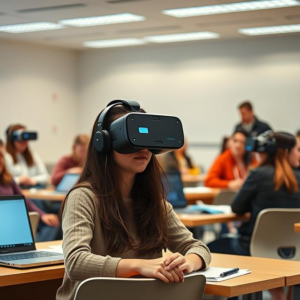
Virtual and augmented reality aren’t new ideas in education, but AI makes them more adaptive and responsive.
Assassin’s Creed Discovery Tour — is a good example because it shows how a detailed game world can be repurposed for guided, educational exploration rather than challenge-driven play. Ubisoft explicitly positions it as a way to explore historical settings through tours and learning content.
This won’t replace teachers, and it won’t suit every subject. But it does hint at a future where “content delivery” is less static, and learning experiences can flex around the learner.
The uncomfortable bits: equity, privacy, and trust
- Equity: if paid tools become the norm, students with more money to get better support. That’s not hypothetical — it’s already a live concern in how AI adoption is distributed.
- Privacy and data: students and staff need clarity about what data is being shared, stored, and used for training. UNESCO flags this directly as a risk area for education systems.
- Accuracy and bias: the DfE has been explicit that AI outputs must be checked; professional judgement still sits with the human using the tool.
If we don’t take these seriously, AI in education becomes either a reputational risk or a quiet driver of inequality — sometimes both.
Final Thoughts
AI isn’t here to “replace education”. What it will do is expose where education has been overly dependent on predictable outputs and hidden labour.
If we respond with smarter assessment, clearer expectations, and a more human-centred teaching role, AI becomes a tool that supports learning rather than undermines it. If we respond with panic and patchwork rules, we’ll get the worst version of both worlds: more workload, more mistrust, and less meaningful learning.
The real question isn’t whether AI belongs in education. It’s whether we’re willing to redesign education so that learning stays visible, defensible, and genuinely worth doing.
What are your thoughts on how education needs to evolve, and what methods would you employ?
Check out other relevant content below:
AI in Construction – This article looks at the impact of AI on the construction industry.
AI in Schools: Pros and Cons – This article explores the benefits and potential drawbacks of integrating AI into education.
Can AI Transform Education? – The Gates Foundation discusses how AI can enhance instructional quality and automate administrative tasks.

Daniel Turing
AI & Technology Analysis
Daniel writes about artificial intelligence, digital transformation, and the wider impact of emerging technology on industries, work, and everyday life. His articles explore how AI is reshaping fields like construction, gaming, and digital creativity, with a focus on practical implications rather than hype.