
The AI and gaming future isn’t just about smarter NPCs — it’s about who gets to make games, how we play them, and what we value.
I’ve been thinking about AI an immense amount lately, and I’ve been trying to get beyond the headlines. It’s already baked into so much of our lives: work tools, creative stuff, search systems, AI summary bots, even the little day-to-day tasks you used to do without thinking. If it’s going to radically shape the next decade, ignoring it would be a weird kind of denial.

I’m also genuinely interested in it. The philosophical side matters to me, and so does the uncomfortable “what does this do to humans?” side that doesn’t fit neatly into a demo video.
And I’m conflicted, because I can see the upside very clearly. I use AI tools myself to bounce ideas around, tighten structure, and give shape to thoughts when my brain is flying in a hundred directions. That use feels like support, not replacement, and it genuinely helps — as long as you stay aware of the current shortfalls and the way speed and prediction can steer everything towards the obvious.
But the question that keeps coming back is simple: useful at what cost?
To keep myself honest, I’ve been thinking about AI in gaming through three angles. The people making games. The systems that shape how games get built. And the player experience — what it actually feels like when you sit down, pick up a controller, and hand a game your time.
As a gamer first, that last one is the one that really intrigues me.
The Holodeck promise is the easy part
Anyone remember the Star Trek Holodeck? Or am I really revealing my age and geekiness there. Either way, games are going to get more impressive, and that’s the least controversial prediction I can make. We’ve been moving towards richer simulation, more believable animation, smarter systems, and worlds that feel less like scripted theme parks.
AI slots neatly into that direction because it can make things react faster and more flexibly than hand-authored design ever could. There’s a version of this future that sounds brilliant: characters that respond naturally, stories that bend without breaking, and worlds that feel alive without being exhausting.
I’m not pretending I wouldn’t want to try it — hopefully without the motion sickness of VR, which is one innovation I’ve had to avoid and swerve, sadly.
But this is where my brain starts tugging the handbrake. If a game can generate anything on demand, what anchors the experience so it still feels authored and intentional, rather than just infinitely… available?
Because “more” isn’t automatically better. Sometimes “more” is just noise with good lighting.
And if I’m honest, this hits close to home as a writer too. I’ve explored the technical side of this stuff, and it’s wild how quickly you can get a model to spit out something that looks like a finished article: give it a title, a topic, a tone, and you can have 500–1,500 words in seconds.
You can refine it, shape it, and even train it to mimic your cadence if you really push. I enjoyed the challenge of figuring out what was possible, but once the novelty wore off, I kept coming back to the same feeling: what is the point of this if the end result doesn’t offer anything real?
It read as generic. It had no weight. And the temptation to churn out slop for reach is obviously there, but if there’s no creative ownership — no sense of achievement or enjoyment — then what are you even building?
That’s where I drew a line for myself. I’ll happily use AI as a tool for idea development and small polish passes, but I won’t let it churn out rubbish on my behalf just for the sake of output.
And that leads me straight to the people behind gaming.
People make games, not pipelines
Games don’t appear out of thin air, and I think we forget that because we mostly meet them as finished products. Behind any game that sticks with you are people making thousands of small decisions: what to cut, what to emphasise, what to keep rough because the roughness is part of the feeling. The details you’d struggle to name are often the ones you’d miss most if they vanished.
AI complicates this because it sits directly in the overlap between creativity and labour. It can be a tool that helps talented people move faster, but it can also become an excuse to reduce the value of the craft itself.
Over time, that shifts the culture from “who made this?” to “does it look fine?”, and that’s a quieter kind of loss. The long-term worry for me isn’t just job displacement in the blunt sense — although that matters immensely — it’s the slow normalisation of vague, generic authorship where human fingerprints become optional and “good enough” becomes the target.
And here’s the part I can’t shake. These models work by predicting the next word, the next step, the most likely continuation. That’s useful, but what happens to the human spark when prediction becomes the default? The strange little deviation from the norm. The unexpected choice. The risky decision that makes a game feel alive.
Once that sort of thinking drifts out, it’s hard to get it back.
When creation becomes effortless, bland can become the default
A lot of memorable games aren’t memorable because they have the most content. They’re memorable because they have intention, restraint, and a specific point of view. Someone decided what the game is, and they also decided what it refuses to become.
AI generation flips the relationship between effort and output because it can fill space instantly and produce endless variations. That can be powerful in the right hands, but it also introduces a drift towards the average. When you can generate a thousand “fine” options, it becomes harder to justify the slower, fussier route that produces something distinctive.
In the AI and gaming future, that drift towards the average could quietly become the default setting unless studios actively fight for a point of view.
You can already see a smaller version of this in AI art and branding. A lot of “retro” outputs look broadly correct and instantly forgettable because they converge towards the same aesthetic soup. Not awful, just oddly interchangeable.
That’s the fear for games too. Not that AI will make bad games, but that it will make an endless supply of technically impressive, perfectly acceptable games that feel emotionally flat.
And honestly, that sounds a bit familiar to modern gaming as a whole at times. Always chasing the safest route to please investors rather than taking a proper, creative swing.
Human creativity isn’t just output; it’s taste, judgment, weirdness, and the happy accidents that happen when you’re working at the edge of your ability. If you remove friction from creation, you might also remove the pressure that produces originality.
Infinite choice can become a self-selected Matrix
The most seductive promise of AI in games isn’t just smarter NPCs or prettier worlds. It’s personalisation: a game that shapes itself around you, always has something fresh ready, and never runs out of content.
That sounds like a dream, especially if you’ve ever bounced off a slow opening hour or felt like a game wasn’t respecting your time. But I can’t shake the idea that this also leads towards a self-selected Matrix.
Not a dramatic dystopia where we’re trapped, but a smooth, frictionless escape we choose because it’s always ready to fill the gap. We’ve already seen how quickly convenience turns into habit, and how easily habit turns into default with doom-scrolling trends.
If games become endlessly responsive and endlessly available, do they become more meaningful, or do they become more disposable? Meaning often comes from limits, from authored intention, from the sense that you’re being guided through a particular experience someone actually meant you to have. If everything can be generated on demand, the risk is that nothing has weight.
It’s the same thought I have about AI-generated art. A machine might reproduce the surface of something beautiful, but it can’t reproduce the human investment that gives it stakes: time spent, intention, struggle, and the fact that a person was there trying to say something that truly meant something to them.
Style can be imitated. Stakes are harder.
If time opens up, what fills it?
People talk a lot about AI reshaping work, and I’m not going to pretend I can predict exactly how that plays out. But I do think it’s worth running the thought experiment, because it links directly back to gaming as a hobby.
If more people end up with more free time for any reason — shorter weeks, job disruption, automation — we won’t just sit in silence. Humans fill space, sometimes well and sometimes badly.
We look for meaning, community, challenge, distraction, and comfort. Gaming is already one of the biggest ways people fill time, so it’s not a stretch to think it could become even more central.
The uncomfortable split is what that time becomes. There’s a version of the future where gaming becomes richer and more intentional, and there’s a version where it becomes an even smoother feed of endless content.
AI can push either direction, because it amplifies both the best possibilities and the worst habits. That’s why this topic doesn’t feel like “tech news” to me.
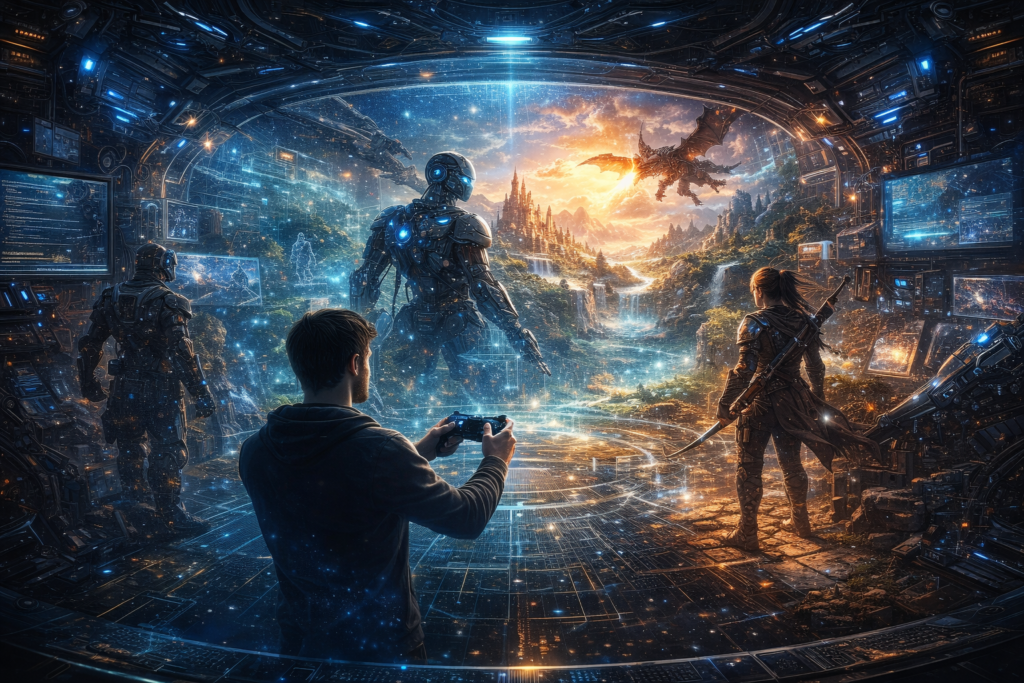
It feels more like a genuinely philosophical question about what we choose to do with ourselves when the friction gets removed.
Where I land, for now, is that I don’t want to treat AI as a villain. I’m using it, I can see its value, and I think it can genuinely help people create who previously felt locked out.
But I also don’t want to pretend the risk is only a footnote about “jobs changing”. The bigger risk, for me, is a quiet flattening: a future where everything becomes AI-shaped by default, and we slowly stop noticing what disappears.
The fingerprints. The odd choices. The rough edges. The sense that a person made this and meant it.
I want the AI and gaming future to be one where tools support human creativity rather than replacing it. Because if everything becomes perfectly generated, perfectly tailored, and perfectly smooth, I’m not sure we end up with better games.
I think we end up with more of them, and a weaker reason to care about any single one.
Take-home message: Holodeck-level immersion will probably arrive, but immersion isn’t the same as meaning. If AI makes creation effortless, the real battle is protecting the human spark — taste, intention, and imperfection — so games still feel worth playing.
Related reading (Retro Tech Tonic)
Jusant Review – the opposite energy: calm, thoughtful, and quietly absorbing when you want something slower.
External links relevant to the topic

Daniel Turing
AI & Technology Analysis
Daniel writes about artificial intelligence, digital transformation, and the wider impact of emerging technology on industries, work, and everyday life. His articles explore how AI is reshaping fields like construction, gaming, and digital creativity, with a focus on practical implications rather than hype.